Sunday, October 25, 2015

Assessment FOR and OF Instruction


Assessment FOR and OF Learning
Realizing that Friday was a lot of information, and a lot of accumulated late hours... I wanted to provide a quick overview of Standard 4: Assessment to bring our conversations about this topic back up to the front of your thinking!

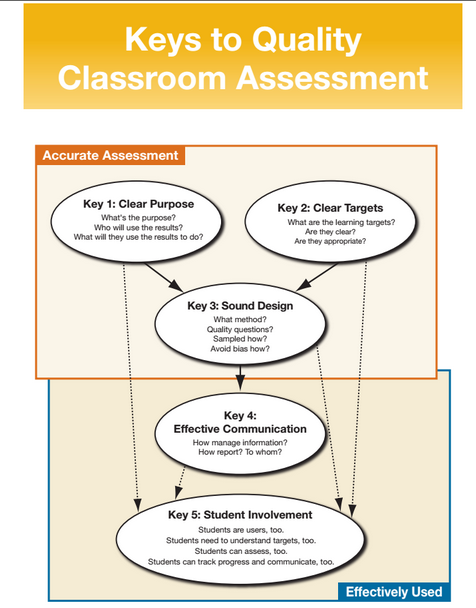
Richard Stiggins' work (Assessment for Student Learning: Doing It Right—Using It Well, 2004) identifies the 5 Keys to Quality Assessment, which we reviewed last week.  As you plan for your instruction this week - and think about ways to assess students' understanding, here are some things to think about:
  • Clear Pupose:   Why am I assessing this?  Who will use the results to inform what decisions?   Is the purpose to impact my instruction, and/or inform other stakeholders (students, parents, district) about how the students are doing?
  • Clear Targets:  An instructor needs to have a clear picture of what achievement is going to be measured. If you don't begin with clear and understandable statements of the intended learning, you won't end up with sound assessments. What am I expecting kids to know and be able to do?  Am I communicating these targets clearly?   What will it look like when they get it?
  • Sound Assessment Design: This key ensures that the assessor has translated the learning targets into assessments that will give accurate results.Which assessment methods are most likely to produce accurate results for the different learning targets?  What is the best way to measure learning for this topic?  How will I check for understanding mid-way through my lesson, to make sure we're on the right track?  How will I check at the end of the lesson to determine my next steps of instruction?
  • Effective Communication:  The instructor must plan to manage information gathered from the assessment appropriately, and report it in ways that will meet the needs of those involved. How will I measure student learning?  How will I keep track of it? How will I let them know their strengths and areas of need?  
  • Student Involvement:  Students learn best when they monitor and take responsibility for their own learning.  How will I get students to interact and engage in the learning?  How will I set the stage to have students track their own progress?  How can I support students in figuring out their next steps?
I know Lori's name came up in many conversations on Friday - please let her know if you'd like her coaching support.  Also, let me know if I can support you in any way.  Whether it be in planning ways to monitor student learning related to your SLO, or figuring out how kids are doing with a concept before the formal assessment - these keys should provide guidance to your thinking.  I am hoping you can take what we talked about regarding assessment,  and integrate it into your daily teaching, so that we can monitor and adjust to best meed the needs of our students.

Thank you, again, for your hard work and engagement on Friday!
Sue


Teacher Standard 4
The teacher systematically gathers, analyzes, and uses relevant data to measure student progress, guide instructional content and delivery methods, and provide timely feedback to students, parents, and stakeholders.

Sunday, October 18, 2015

Balancing Act


Balancing Act

There are two important aspects of teaching:  data and curriculum AND building relationships.  This past week has been filled with both!  As you prepared for conferences, you studied your students so that you got to know their strengths and weaknesses, and then used your assessment data to confirm your thinking.  You shared what you knew about your students with their families in an effort to build a collaborative relationship between home and school.

As we all know, the data piece of our job is important.  We will continue to look at data as we go through grade level roll thrus this week to look at current reading progress.  On Friday, we will talk about how to use assessment to gather data, and then how to use our data as we begin to write our SLOs.  Data helps drive what we do every day. But  what is impressive is how you do the other half of your job.  Each of you work diligently to get to know your students and their families, and you are constantly problem solving ways to best meet students' needs.  You are creating personalized interventions, adjusting your schedule to accommodate behaviors, communicating with parents to work together on concerns,  providing opportunities for students to showcase their strengths, setting high expectations and letting kids know you believe in their ability to reach them... going above and beyond to support the needs of your students.  It is through this hard work that you remind your students that you believe in them, and you care deeply about them.

As I walked around during conferences last week, I heard from many parents about how happy they are with all of the teachers at Houlton.  You are good at what you do.  I can't tell you how many times I have been told how lucky I am to work with the Houlton staff.  And I absolutely agree! You make it look easy to find the balance between the business (data and curriculum) and the pleasure (building relationships) of this really exhausting job!

Thanks for all you do... You are masters at a very difficult balancing act!

Sunday, October 11, 2015

Conference Time!


Conferences are an important time to connect with families, and to provide an update on how things are going these first six weeks of school, both academically and socially.  I am impressed how well you know your students, have data to share, and how we are our student's  biggest advocate, cheerleader, and coach.    We are fortunate at Houlton to have such supportive and involved families - they are grateful to have their students here!

Here are some tips:

  1. Send a questionnaire home to get a focus for parent concerns.  This gives you a heads-up if there's something you need to prepare for.
  2. Take the "sandwich" approach. Start with something positive, continue with the things that the child needs to work on, and finish with something positive.
  3. Plan the essential things you want to share - strengths and an area to work on, including essential data and work samples.  Don't feel like you have to discuss MAP and PALS assessments.  We will have those printed out for you, along with explanation letters.
  4. Listen and respond to parent concerns.  Sometimes they have insight, or hear things, that we aren't even aware of!  Our goal is to make Houlton a productive learning environment - and parent input is an important part of that!
  5. Describe areas of difficulties and accommodations you are doing to support them - but don't diagnose students.
  6. Speak about your student the way you want someone to talk about your own child
  7. Get support from Sue or Kristen as needed!  Email us to let us know - and we'll be there!
Optional Resources for Conferences.


Sunday, October 4, 2015

Leadership and Learning


According to the Center for Educational Leadership, instructional leadership is guided by these principles:
    • Instructional leadership is learning-focused, learning for both students and adults, and learning which is measured by improvement in instruction and in the quality of student learning.
    • Instructional leadership must reside with a team of leaders of which the principal serves as the "leader of leaders."
    • A culture of public practice and reflective practice is essential for effective instructional leadership and the improvement of instructional practice.
In the upcoming week, I will be starting my first round of drop in and informal visits.  An instructional coach at heart, I am very excited to see your work in action. Through this process, I have three goals: 
  • I want students to see me involved in their learning.  Our work at Houlton is a collaborative effort that includes everyone, and I want our students to recognize that they have an entire team on their side, leading them to success.
  • I am a learner myself, and gravitate towards opportunities that provide me with new ways to think about things.  Through my nine years as an instructional coach, I have been inspired by the work I have seen across the district, and continue to seize the opportunity to process all of the highly effective instructional strategies I observe in Houlton's teachers each day.  This, in turn, allows me to continue to support and lead others in their continued growth.
  • As a team of leaders, it is our job to reflect on our instructional practices.  It is my goal, my responsibility, and my privilege, to provide you with feedback that will lead you to continue to grow and learn as an educator.  This is an exciting, and very natural, part of my job.  And the result?  Learning for both students and teachers.

I look forward to our work together!
Sue

Sunday, September 27, 2015

Teaching Tools


Over the last week or two, you have been given lots of things to think about when it comes to your work in the classroom.  As you plan your path ahead, here are some things to think about...

WHAT to teach...
Hudson's SMART Goal is focused on reading.  At the elementary level, reading skills and strategies are aspects of just about everything we teach.  When you think about your instructional goals for the year, it will be helpful to focus on reading, as it will be the district priority for professional development, Day 6 collaboration, and the development of your SLO.  Houlton's SMART Goal Action Plan breaks down our reading work into three areas: achievement (grade level expectations), growth (for all students), and closing the gap (identified students who aren't reaching their expected growth).

HOW to teach it...
Our Educator Effectiveness Priority Standards are Instructional Delivery, Assessment, and Learning Environment.  Most recently, we dug into Standard 3: Instructional Delivery.  Think back on the conversations you had in your table groups, and reflect on some of the ideas you considered implementing.  An area we are going to dig into as a school is engagement.  What can you do to engage your students, in both whole and small group instruction?

SUPPORT for teaching...
As mentioned above, the district is supporting the SMART Goal and the Teacher/Specialist Priority Standards through staff development, district-wide collaborative lesson planning, and time set aside to dig into these areas.  In addition, our Instructional Coach is here to offer support in instructional areas you are focusing on.  Most recently, Lori introduced Student Centered Coaching, which puts the needs of the students front and center.  Through this approach, coaching is focused on specific goals for student learning, and Lori can work with you on a plan that will have an impact on increased student achievement.

Seven Core Practices for Student-Centered Coaching
  1. Setting student learning goals for coaching cycles
  2. Creating learning targets for coaching cycles
  3. Using student evidence to co-plan instruction
  4. Organizing coaching through coaching cycles
  5. Co-teaching with a focus on effective teaching practice
  6. Measuring the impact of coaching on student and teacher learning
  7. Partnering with the school leader

Please let me know how your work can be supported. 
There's a lot of pieces to put together, 
and I'm here to help!

Have a great week!

Sue

OPTIONAL: First Month Feedback survey


Sunday, September 20, 2015

September 24  Late Start 
Standard 3: Instructional Delivery


The district has identified three priority standards, which we will be digging into in the upcoming Late Start/Professional Learning days. This Thursday is our first Late Start, and we'll be looking at Standard 3. 

The HSD Vision for Thursday is:
  1. Hudson educators know, understand and practice at the effective and distinguished levels in each of the Stronge Educator Standards.
  2. More importantly, Hudson educators have a strong sense of efficacy about their profession, leading to increased student learning.
Below are some things to look at to get your thinking started... Instructional Delivery is something you do each and every day - how can we fine tune it to make sure it includes high impact strategies that meet the needs of our students?


Here is the presentation for Thursday from 8-10:30.
Bring a device and your log in for My Learning Plan

Looking forward to our learning together on Thursday!

Sue

Teacher Standard 3 ~ Instructional Delivery (Priority Standard)
The teacher effectively engages students in learning by using a variety of instructional strategies in order to meet individual learning needs.


Criteria
Distinguished
Effective
Developing/Needs Improvement
Unacceptable

In addition to meeting the effective standard, the teacher optimizes students’ opportunities to learn by engaging them in higher-order thinking and/or enhanced performance skills
The teacher effectively engages students in learning by using a variety of instructional strategies in order to meet individual learning needs.
The teacher inconsistently uses effective instructional strategies that meet individual learning needs.
The teacher does not use effective instructional strategy or inadequately addresses students’ individual learning needs.


  • How do I stay involved with learning targets throughout the entire lesson?
  • How do I connect the real world with content?
  • How do I incorporate higher-order thinking strategies (metaphors/analogies,compare/contrast)?
  • How do I maximize higher-order questioning?
  • How do I integrate standards with other content?
  • How do I engage students through collaboration and active learning?
  • How do I involve every learner in intellectual work?
  • How do I create open-ended problem solving/inquiry?
  • How do I facilitate learning?
  • How do I incorporate students’ creativity and design?
  • How do I use instructional approaches and techniques that are based on student choices, interests, passions, and ambitions?


Specialist Standard 5: Program Delivery (Priority Standard)

Distinguished
Effective
Developing/Needs Improvement
Unacceptable
The educational specialist uses professional knowledge in an innovative manner to provide a variety of exceptional services for the targeted learning community. 
The educational specialist uses professional knowledge to implement a variety of services for the targeted learning community. 
The educational specialist attempts to use professional knowledge to implement services, but efforts are inconsistent in addressing the needs of the targeted learning community. 
The educational specialist rarely uses professional knowledge to implement services to meet the needs of the targeted learning community. 
  • How do I select, develop, organize, implement, and support curriculum for specific learner and/or program needs?
  • How do I use technology, materials, and other resources to deliver services and programs?
  • What varied and personalized strategies or approaches am I using to meet the needs of the learning community?
  • What specific examples demonstrate my collaboration with instructional staff to design, implement, or support services for specific learner or program needs?
  • What methods do I use to consult with administration, parents, community agencies, school, and support personnel to resolve issues and/or communicate progress related to the provision of programs/services to individual learners?
  • How do the services I provide  support mastery of state and national standards?
  • How do I interpret policies, programs, and procedures related to the delivery of services to learners?


    Reflective Questions of Specialist Standards

Sunday, September 13, 2015

Bucket Fillers


Fill a Bucket
Our mission is to create a world of bucket fillers. A person can be a bucket filler or a bucket dipper. The way to fill a bucket is to be kind to someone.

For our Students...
Our students come to school each day with a variety of experiences - some bucket filling, some bucket dipping.  As an educator, our hope and dream is to be the bucket filler for all of our students.  There are days that it is difficult, when our patience is being tried, but try to remember that positive teacher-student relationships can enable students to feel safe and secure in their learning environments, and provide the scaffolding for important social and academic skills (Baker, et al, 2008).  In addition, teacher-student relationships can have a significant effect on the peer acceptance of students. Teachers' interactions with students can affect classmates' perceptions of individual students, in turn affecting which students classmates choose to interact with and accept (Hughes, et al, 1999). So the bucket filling you do will have a huge impact on the social and academic success of your students.

For each other...
The Houlton staff family knows each other so well that you all just seem to know what each other needs. The bucket filling to each other is endless. I have seen you do things such as adjusting a recess schedule to accommodate others, cleaning tables for a colleague, writing positive notes in the staff lounge, helping each other with challenging students and/or transitions, being flexible with intervention times - compromising to help meet the needs of a teacher or team, or to best meet the needs of the entire school.  These all showcase our way of doing something for others - filling a bucket by being kind to someone.  Your actions serve as an inspiration to adults, and build you as a role model to our children.

This bucket filling for each other not only contributes to our colleagues, but it has a positive impact on our students.  It is no surprise that students of high-ability teachers outperform those of low-ability teachers, but studies have also found that gains are highest among students whose teachers were both high-ability AND have stronger ties with their colleagues.  Research has found that even lower-ability teachers can perform as well as teachers of average ability if they have strong relationships with coworkers.  When teachers trust one another, they are more likely to reveal their weaknesses, and perhaps even address them, using the support and guidance of their peers (Washington Post, September 10, 2014). 


So continue your work as Bucket Fillers.  Collaborate, compromise, be playful, work hard, make student success a priority - and continue to support your students, and each other, in this exhausting yet invigorating journey called education.


Bucket Filling Song (if you want to introduce this concept to your students)